3 Ways to Speed Up Your Home Wi-Fi Network & Extend Coverage
Updated for September 2026 | Ultimate Home Internet Optimization & Hardware Guide
How to Speed Up Home Wi-Fi Summary: Sluggish internet connections are usually caused by bandwidth congestion, router placement errors, or physical range limits. You can effectively speed up home wifi by applying three practical strategies: clearing network interference, strategically positioning a plug-in expansion device, and using wired LAN pass-through for high-demand streaming.
1. Understanding Why Home Wi-Fi Slows Down
Buffering icons, lagging video calls, and slow file downloads are common frustrations in modern households. Before trying to speed up home wifi, it helps to understand why performance degrades as distance increases.
According to technical standards published by the Wi-Fi Alliance, radio frequencies operating at 2.4 GHz offer great range but are prone to heavy channel crowding from neighboring networks, Bluetooth units, and household appliances. As signal strength drops, your router automatically throttles data transfer rates to prevent packet loss.
2. Method 1: Router Placement & Channel Optimization
The first step to improve wifi signal strength costs nothing and takes only minutes:
- Elevate and Center Your Router: Radio signals travel outwards and downwards. Placing your router on a high shelf in a central hallway helps distribute signals evenly.
- Clear Physical Obstacles: Avoid tucking routers behind TVs, inside wooden entertainment centers, or near thick concrete walls that cause signal degradation.
- Reboot Regularly: Restarting your router clears short-term memory cache and forces the device to select the least congested wireless channel available.
3. Method 2: Expand Coverage with WiFi Boost Pro Optimization
While router repositioning helps, physical distance remains a hard limit. To truly boost internet speed at home in far-off bedrooms or home offices, introducing dedicated expansion hardware is essential.
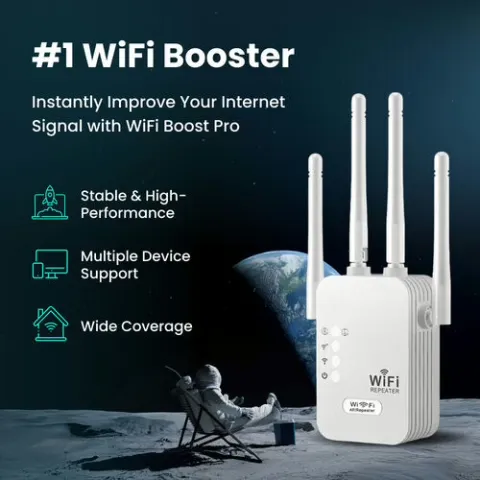
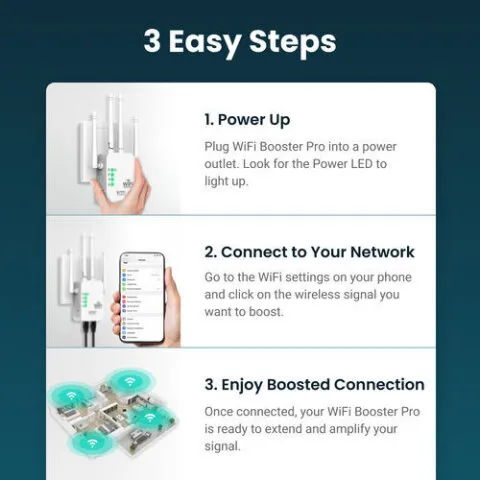
Applying a wifi boost pro optimization strategy involves plugging a compact repeater into an outlet midway between your primary router and weak zones. The unit captures the clear signal, amplifies it, and rebroadcasts strong Wi-Fi into previously laggy spaces.
4. Method 3: Use LAN Connections to Reduce Wi-Fi Buffering
If high-bandwidth activities like 4K streaming or online gaming suffer from packet drops, leveraging a wired connection is the most reliable way to reduce wifi buffering.
Modern plug-in devices like WiFi Boost Pro include an integrated 10/100 Mbps Ethernet port. By running an Ethernet cable directly from the booster to your Smart TV, PC, or gaming console, you bypass wireless airtime interference entirely, achieving rock-solid stability.
5. Complete Home Wi-Fi Resource Hub
Explore our full series of guides to master your home network, troubleshoot issues, and maximize hardware efficiency:
- Hardware Hands-On Review: Read our complete WiFi Boost Pro Review for spec breakdowns and performance tests.
- Easy Installation: Follow our step-by-step WiFi Boost Pro Setup Guide for fast 5-minute configuration.
- Device Comparison: See how compact boosters compare in our WiFi Booster vs Range Extender Comparison.
- Troubleshooting Dead Zones: Learn how to eliminate weak spots in our guide on How to Fix Wi-Fi Dead Zones.
6. Frequently Asked Questions (FAQ)
7. Summary & Recommended Action Plan
You don't need expensive monthly provider upgrades to enjoy fast, reliable internet. By optimizing router positioning, eliminating physical obstructions, and introducing a compact expansion device, you can easily speed up home wifi and improve wifi signal strength across your entire home.
Take control of your home network today and enjoy seamless streaming in every room!